The True Cost of "In-Network": Why Cash-Based Physical Therapy is the Smarter Investment
In places like New York City, Miami, Fort Lauderdale, Boca Raton, South Florida area, we are fortunate to have access to some of the best healthcare networks in the country. On the surface, choosing an "in-network" physical therapy clinic seems like the obvious choice—you pay your monthly premiums, so why not use the benefit?
Traditional insurance-based physical therapy is a vital part of our healthcare system, especially for basic rehabilitation. However, for those seeking high-level performance, resolution of chronic "mystery" pain, pelvic floor therapy, issues like erectile dysfunction, vaginismus, constipation, or a truly personalized experience, the traditional model often carries hidden costs that don't show up on a co-pay receipt.
The "Volume" vs. The "Value" Model
To understand the difference, we have to look at how these clinics operate behind the scenes.
Traditional In-Network PT: The High-Volume Approach
Because insurance reimbursement rates for physical therapy have declined steadily over the years, in-network clinics are often forced to adopt a "volume-based" model to stay open.
The Experience: You may find yourself in a large, busy gym. You will most likely be working with a great therapist, but, he or she might be juggling 2, 3, or even 4 patients at the same time.
The Staffing: You might spend 15 minutes with a Licensed Physical Therapy, but the rest of your hour is spent with an aide or assistant who isn't a licensed specialist.
The Frequency: Because the one-on-one time is limited, these clinics often require you to come in 2 or 3 times per week for several months.
Cash-Based PT: The One-on-One Approach
In a cash-based (out-of-network) model, the "middleman" of the insurance company is removed. This allows the clinic to prioritize quality over quantity.
Undivided Attention: Every minute of your 60-minute session is spent one-on-one with your specialist.
Expertise Only: There are no aides or assistants. You are working with a specialized, experienced Physical Therapist who can perform high-level manual techniques (like IPA or Barral) that require constant assessment and learning.
Efficiency: Because the care is so concentrated and specialized, most patients only need to visit once a week—or sometimes once every two weeks.
The Hidden Value of Going Out-of-Network
When you look at the big picture, the "more expensive" cash-based session often ends up being the more economical and effective choice.
1. You Recover Faster with Fewer Visits
In the traditional model, you might attend 12–15 sessions over 6 weeks. In a cash-based model, many patients achieve the same (or better) results in just 4–6 highly focused sessions. When you factor in the cost of your time, travel, and time away from work, the cash-based model often wins.
2. Your Care is Dictated by You, Not an Adjuster
Insurance companies often have "caps" on how many sessions they will allow or which body parts can be treated. In a cash-based setting, we treat you, not a diagnosis code. If your pelvic pain is being driven by a hip restriction or a ribcage misalignment, we address it all in one session without waiting for an insurance adjuster’s approval.
3. Transparency and No Surprise Bills
We’ve all received a medical bill three months later for a "denied claim" or an unmet deductible. With cash-based PT, you know exactly what you are paying upfront. No surprises, no hidden fees. Plus, many patients can still submit their receipts (superbills) to their insurance for out-of-network reimbursement.
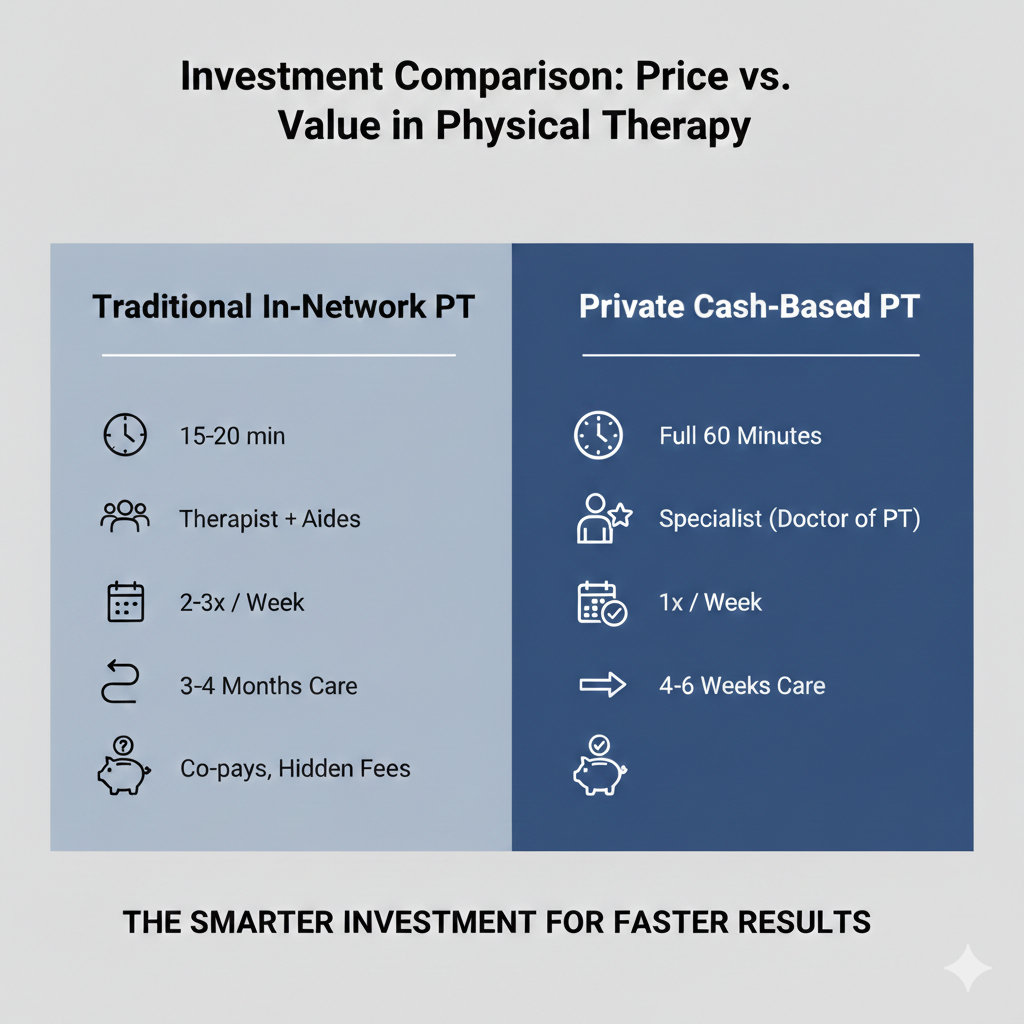
At first glance, a $50 co-pay seems more attractive than a private pay rate. However, when you consider that a private session provides 4x the amount of expert one-on-one care, you are essentially accomplishing in one visit what would take a month in a high-volume clinic. When you value your time and the speed of your recovery, the private model is designed for maximum efficiency
A Personalized Partnership for Your Wellness
Ultimately, traditional PT has its place in the healthcare system. Whether you are an athlete in Miami looking to shave seconds off your time, or a professional in Manhattan trying to eliminate chronic pain without surgery, the model of care matters.
The goal of private, one-on-one physical therapy is to get you back to your life as efficiently as possible. When you factor in the value of your time, the quality of the intervention, and the speed of your recovery, the "expensive" option often turns out to be the most economical one.